Search Results
Subject is exactly
Nudes in art
Use buttons below to view additional pages.
-
Codex de La Llorona de la Diosa de Maize
title Codex de La Llorona de la Diosa de Maizedescription From the Codex Series, the artist visualizes a story that she learned from her mother. La Llorona emerges from the maguey which has a fetus. The diosa stands behind a corn plant, appropriated from a codex. Among the icons associated with La Llorona and the Corn Goddess are corn, cacao, water, a fetus, plants, a fertility symbol, and the sundial. Marble dust sourced from Mexico is used to create texture. Acrylic on canvas. Dimensions: 39 ¾" x 43 ½"artist/creator Barraza, Santasubject Calendar art Feminism Chicana art Tejana art Symbols Appropriation Hieroglyphs Codices Postmodernism La Llorona Maguey Corn goddess Indigeneity Landscapes Maiz Nudes in art Paintings Sun ray Tattoos Tonallicontributor Santa C. Barraza -
Cihauteteo con Coyolxauhqui y St. Philomena
title Cihauteteo con Coyolxauhqui y St. Philomenadescription From the Mujeres Nobles Series, the artist printed her serigraph onto canvas and attached the image onto another canvas, on which she painted a house and other elements around the collage. The healing tree and cloud locate the artist in South Texas. The ollin hieroglyph appears in the foundation of the shotgun style house, an architectural style well-known in Texas. St. Philomena, the child martyr, appears above the home to safeguard it. Multimedia. Dimensions: 60" x 50”artist/creator Barraza, Santasubject Yellow Rose of Texas Occupied America Oztotl glyph Atlatl dart Coyolxauhqui (Aztec deity) La Llorona Chicana art Tejana art Borderlands Conquest Feminism Frontera Hieroglyphs Maguey Nudes in art Paintings Roses Symbols Tattooscontributor Santa C. Barraza -
Coyolxauhqui como Sirena
title Coyolxauhqui como Sirenadescription From the Codex Series, this painting is a feminist reimagining of Coyolxauhqui as a mermaid in South Texas. She wears Coatlcue's talisman of hearts and hands around her neck and a coral snake as a headdress. Much of the imagery is appropriated from the codices, including hieroglyphs and iconography. The green jay on Coyolxauhqui's shoulder locates the artist's presence in South Texas. Acrylic on canvas. Dimensions: 35 ½" x 35 ½"artist/creator Barraza, Santasubject Feminism Chicana art Tejana art Symbols Appropriation Coyolxauhqui (Aztec deity) Calendar art Hieroglyphs Codices Birds Paintings Nudes in art Postmodernism Tonallicontributor Santa C. Barraza -
Figurative Composition
title Figurative Compositiondescription The painting was created as a class project focusing on modular style. Here, the artist used a human figure which was then abstracted. She also used this assignment to challenge her use of color. Acrylic on canvas. Dimensions: 48" x 32"artist/creator Barraza, Santasubject Paintings Figurative art Abstraction Chicana art Tejana art Concentric patterns Nudes in artcontributor Santa C. Barraza -
La Llorona II
title La Llorona IIdescription The monumental painting depicts La Llorona in occupied America, as indicated by the cave hieroglyph, oztotl, pierced by the atlatl dart. The maguey gives energy and life to La Llorona. The composition of the water in the background is informed by the artist's study of the Mesoamerican codices. Oil on canvas. Dimensions: 48" x 87"artist/creator Barraza, Santasubject La Llorona Maguey Water Landscapes Tattoos Codices Oztotl glyph Sacred Hearts Corazón sagrado Conquest Atlatl dart Symbols Hieroglyphs Nepantla Indigeneity Genesis Nudes in art Chicana art Tejana art Occupied America Borderlands Frontera Paintings Roses Yellow Rose of Texascontributor Santa C. Barraza -
Mi Duende Teasing Me
title Mi Duende Teasing Medescription This print is from the Dream Series. The nude figure holds the steps to the Underworld on her vulva, and the hair on her head is energized with movement. Monoprint. Dimensions: 22" x 28"artist/creator Barraza, Santacontributor Santa C. Barraza -
Mujeres de Nepantla
title Mujeres de Nepantladescription This painting was created during a residency of the Nepantla Project organized by Gloria E. Anzaldúa (1942-2004) in Saratoga, California. The central image is La Llorona, who emerges from the water and from the cipactli, the crocodile. Shells, fish, and Coyolxauhqui's body parts float in the water, and the profile of her face appears in the moon. The tattoos on the two faces of La Llorona are appropriated from the codices. The soul of the fetus that she carries rises behind her. On the left, Malinche emerges from the maguey, and on the right, the artist's grandmother, Andrea, appears with a javelina, which locates the artist in South Texas. Other symbols are the butterfly, the hummingbirds, and the double-headed horse, appropriated from José Clemente Orozco. Oil on canvas. Dimensions: 63" x 72"artist/creator Barraza, Santasubject Chicana art Feminism Coyolxauhqui (Aztec deity) Nepantla Symbols Hieroglyphs Hummingbirds Maguey Javelina Paintings Tejana art La Llorona Tattoos Codices South Texas Butterflies Visual quotation Abuelas Mestizaje Malinche Moon Duality Indigeneity Nudes in art Portraits Rabbitscontributor Santa C. Barraza -
Teotl
title Teotldescription This drawing was created during a residency of the Nepantla Project organized by Gloria E. Anzaldúa (1942-2004) in Saratoga, California. The artist reimagines Michelangelo's representation of the Creation of Man as portrayed in the Sistine Chapel. Rather than God touching Adam to bestow life force, the artist presents a feminist and Indigenous moment of creation. The central image is La Llorona, whose face has tattoos that signify death, and thus infinity, as she emerges from the maguey. Coyolxauhqui's hand reaches down from a cloud and touches the maguey, which animates La Llorona, giving her life. Rain drops depicted as the Eye of God nourish the earth and prepare the soil for harvest. The outer band produced in acrylic paint contains symbols of South Texas, hieroglyphs, and parts of the Moon Goddess's body. Charcoal drawing and acrylic on canvas. Dimensions: 112" x 74"artist/creator Barraza, Santasubject Drawings Tattoos Maguey Coyolxauhqui (Aztec deity) Codices Oztotl glyph Rabbits Moon Eye of God Ojo de Dios Conquest Atlatl dart Symbols Hieroglyphs Nepantla Indigeneity Genesis Nudes in art Landscapes Chicana art Tejana art Borderlands Feminism Flint Frontera Occupied America Ollin Roses Serpents in artcontributor Santa C. Barraza -
Mojada
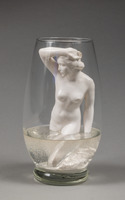
title Mojadadescription Commercially manufactured glazed ceramic, glass and resin / cerámica vidriada y vidrio de fabricación comercial y resina. 11" x 6 1/2" x 6 1/2".artist/creator Mondini-Ruiz, Francosubject National Museum of Mexican Art (NMMA) 25th Anniversary Donation Found objects Women Nudes in art Conceptual art Immigration Humor Identity Undocumented immigrants Noncitizens Immigrants Sculpturecontributor National Museum of Mexican Art (NMMA) -
Homenaje a Frida Kahlo II
title Homenaje a Frida Kahlo IIdescription Serigraph, N.N. Serigrafía, S.N. 22 1/4" x 17 1/16" (paper size).artist/creator Cervántez, Yreina D.subject Sexuality in art Kahlo, Frida, 1907-1954 Guadalupe, Our Lady of Jaguars Flowers Animals Women Femininity Reflections Identity Birth Parades Reproduction Women artists Self Help Graphics and Art (SHG) Nudes in artcontributor National Museum of Mexican Art (NMMA) -
Lágrimas entre sollozos
title Lágrimas entre sollozosdescription Etching and aquatint, 17/100. Aguafuerte y aguatinta, 17/100. 15 1/4" x 11 3/8" (paper size). From The Song of Paper portfolio.artist/creator Bringas, Tomássubject Religion in art Spirituality Figurative art Portfolios Chicago artists Taller Mexicano de Grabado Hands Symbolism Symbols Nudes in artcontributor National Museum of Mexican Art (NMMA) -
American Dream
title American Dreamdescription Color lithograph on paper, 34.5 in. x 24.5 in. A popular sculptor from El Paso, Luis Jiménez personifies the “American Dream” in the automobile, a symbol of material wealth and privilege in American society. The car is a product of the industrialized machine age, which provides a mode of transportation and is a status symbol. Here, a blond-haired woman lies in an embrace with a sports car, a luxury for most Americans. Jiménez references Greek mythology in the legend of Leda and the Swan, the wife of a king seduced by Zeus in the guise of a swan. Jiménez also interprets the story of the Olmec were-jaguar, born from the union of a jaguar and woman. Associated with the Pop Art movement in his early career, the artist produced a fiberglass sculpture of the same name in 1969 to speak to Americans and their intense obsession with their cars. Luis Jiménez was prominently featured in Dr. Jacinto Quirarte’s Mexican American Artists (1973), one of the first books on Mexican American and Chicano art.artist/creator Jiménez, Luissubject Sexuality in art Nudes in art Cars Automobiles Color lithographs Lithographs Prints Life and Experiences in the U.S./Mexico Borderlands (exhibition)contributor Mexic-Arte Museum (MAM)